


Global AI spending reached $2.59 trillion in 2026 — a 47% jump from the prior year — and Gartner expects the broader AI market to hit $3.3 trillion by 2027. The infrastructure buildout alone tells the story: companies are expected to spend $1.75 trillion just on AI infrastructure in FY27. Wall Street analysts now estimate total AI capital expenditure will climb above $1 trillion in 2027 — with Amazon alone projecting $200 billion in buildout this year.
The ambition is real. The investment is real. The problem is — so is the failure.
The Uncomfortable Truth About AI Projects
Here’s what the data actually shows:
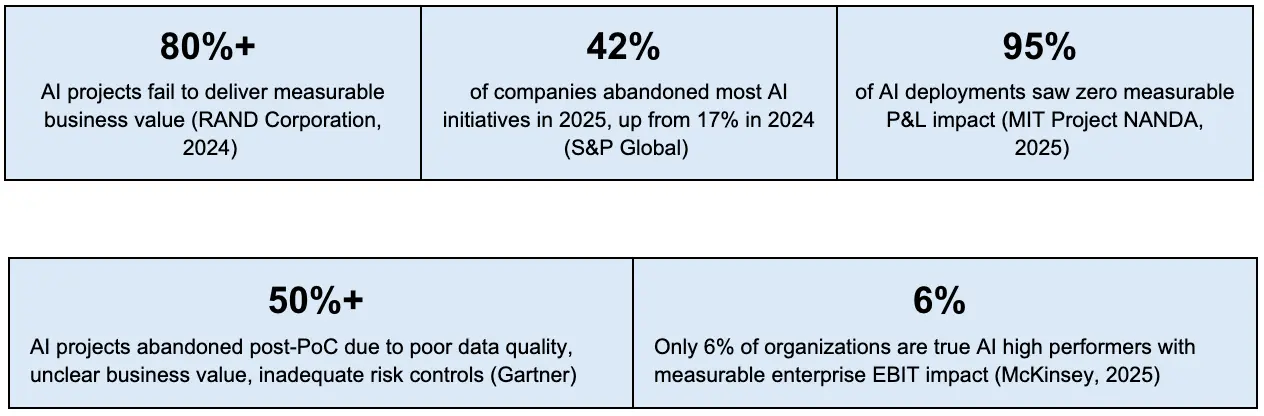
The numbers are jarring. But the reason behind them is consistent, and it’s almost never the technology itself.
“Despite the enormous potential business value of AI, it isn’t going to materialize spontaneously. Success will depend on tightly business-aligned pilots, proactive infrastructure benchmarking, and coordination between AI and business teams to create tangible business value.” — Gartner
The failure isn’t a technology problem. It’s a framing problem.
The Right Starting Point: Think Big, Start Narrow
There’s a tempting instinct in AI transformation — to think holistically, architect comprehensively, and boil the ocean before the first cup of tea. Vision matters. But in AI, a sweeping vision without a disciplined starting point is a reliable path to a stalled pilot and a disappointed leadership team.
The organizations that succeed don’t start with a platform. They start with a question — specific, real, consequential — one that, if answered well, changes a real decision.
An AI Proof of Concept (PoC) is the right vehicle for that kind of disciplined start. Done well, it validates assumptions, surfaces constraints, and tells you what’s actually true about your data, your workflows, and your readiness — before you’ve committed to a full production build.
But here’s where most organizations get it wrong: they treat the PoC as a technology showcase rather than a business learning exercise. They measure success by whether the demo looked impressive — not whether the output changed anything real.
Four Principles That Separate The 6% From The Rest
1. Narrow the problem before you widen the solution
McKinsey’s top-tier performers designed their PoC around a real business decision, not a model capability. “Can AI do X?” is the wrong question. “Will AI change how we make decision Y?” is the right one. The narrower the scope, the sharper the signal. A PoC that tries to solve everything teaches you nothing. A PoC that answers one precise question teaches you everything you need to move forward.
2. Build with real-world constraints, not ideal conditions
Gartner found 63% of organizations either don’t have — or aren’t sure they have — AI-ready data. A model that works beautifully on a curated PoC dataset but degrades on messy production data isn’t ready to scale. It’s ready to disappoint. A rigorous PoC tests against real constraints: actual data quality, integration with live systems, the edge cases that will occur in production, and the humans who will actually operate it day-to-day.
3. Make the output something a human can actually act on
Too many AI outputs sit in dashboards no one looks at, generate summaries no one reads, or surface recommendations no one knows what to do with. MIT’s research is clear: flawed enterprise integration — not model quality — is the core reason pilots stall. A well-built PoC doesn’t end with a model. It ends with an answer to: “Who does what differently, and when, because of this output?”
4. Define what success looks like before you start
McKinsey 2025 found that nearly 73% of AI initiatives never make it beyond the pilot stage — and the reason is usually not technical. It’s that the organization never clearly defined what business success was supposed to look like at the outset. Gartner Analyst Melanie Freeze noted that 57% of leaders whose initiatives failed “expected too much, too fast.” Success criteria need to be defined upfront, grounded in business metrics, and agreed upon by both technology and business stakeholders — not retrofitted after a demo.
What a Well-Run PoC Actually Delivers
Here’s what the 6% understand that the rest haven’t caught onto yet: the value of a PoC is not the prototype. It’s the clarity.
At The End of a Well-Run PoC, You Get
- An honest, evidence-based feasibility assessment
- A clear view of what your data can and cannot support
- An understanding of the organizational changes required to make AI work in production
- A credible, defensible answer to the question: should we build this at scale?
That clarity — especially a well-reasoned “not yet” — is often worth more than a shiny prototype that collapses under production conditions six months later.
How we Approach This at Bajaj Tech.AI
At Bajaj Tech.AI, we engage with clients with a simple but deeply held belief: AI creates real value at the intersection of business understanding, technical depth, and execution experience. None of those three alone is sufficient.
We start every engagement by working closely with you to narrow the problem — not just technically, but commercially.
- What decision needs to change?
- What data do you actually have versus what you think you have?
- Where does the human need to stay in the loop?
We bring practitioners into every engagement — people who have moved AI initiatives from whiteboard through into production. Domain understanding, engineering depth, and execution experience — all working together from the start.
We’ll help you turn an idea into a visual, a workflow into a demonstration, and a question into a concrete answer. If the PoC succeeds, you’ll know exactly how to scale it. If it reveals a gap, you’ll know that too — learned at PoC cost, not production cost.