


According to FinOps and IDC research, 60% of enterprises underestimate the ongoing management and optimization costs of a cloud migration, and organizations typically spend 25–35% more than planned in the first 12 months after moving almost entirely due to overlooked operational costs, not the migration itself. For a platform decision as foundational as Adobe Experience Manager (AEM) deployment, getting this choice wrong isn’t a technical inconvenience, it’s a multi-year cost and agility problem.
This blog breaks down the three ways enterprises can run AEM Cloud Service, On-Premises, and Adobe Managed Services (AMS) what actually differs between them, and the factors that should drive the decision, especially for regulated industries like BFSI where compliance and data control carry as much weight as cost.
What Are the Three AEM Deployment Options, and How Do They Actually Differ?
The three models differ primarily in who manages what infrastructure, application, and data not in the core AEM product itself.
- AEM as a Cloud Service: Adobe fully manages the infrastructure, scaling, and platform updates. Your team focuses entirely on content, configuration, and experience delivery. It’s built for continuous deployment, with new features and security patches rolled out automatically rather than through scheduled upgrade projects.
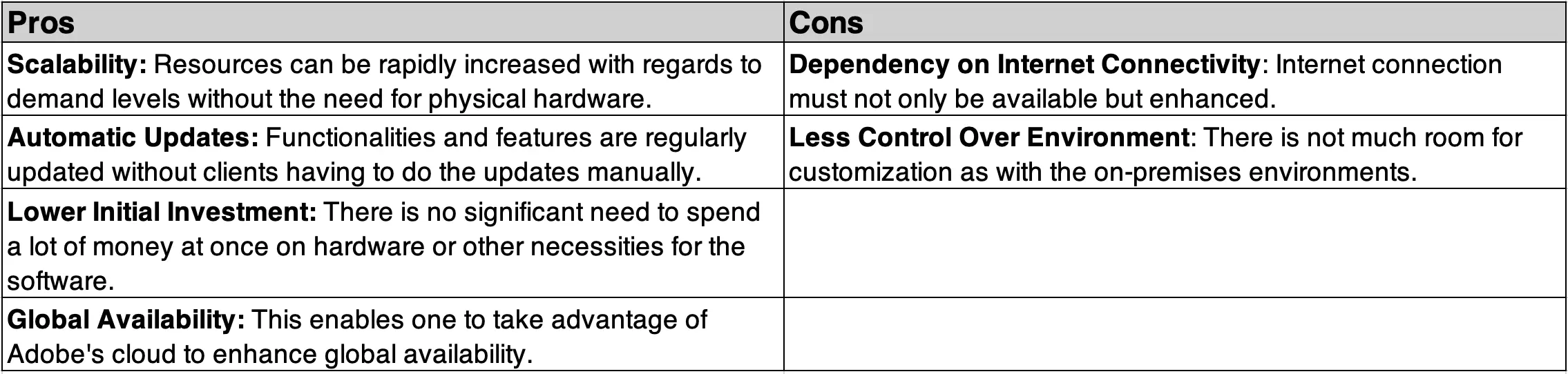
Ideal For : It is meant for organizations needing flexibility and fast deployment, without too much management of the IT resources, especially those expecting expansion.
2. AEM On-Premises: The application runs entirely on your own servers, managed by your own IT team. This gives an organization complete control over infrastructure and data location, at the cost of owning every layer of maintenance, scaling, and security patching in-house.

Ideal For : Organizations that have standard compliance requirements, have operational IT infrastructure or the organizations which require full in most cases, Off-premises server hosting providers remain beneficial to those businesses that attain a proper understanding regarding their data management behaviour.
3. Adobe Managed Services (AMS): A middle path. Adobe (or an Adobe-authorized partner) manages the underlying infrastructure and operations, while your team retains control over application configuration and data governance without taking on full infrastructure ownership.
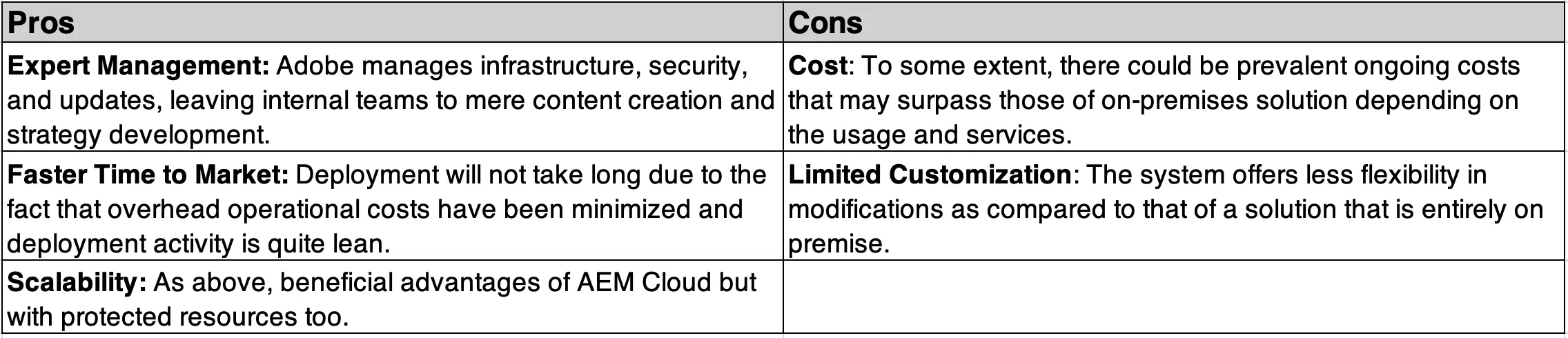
Ideal For : Companies wanting the best of both worlds managed services for infrastructure while retaining control over application settings and data
The practical difference comes down to a simple question: how much operational ownership does your organization want to retain, and how much does it want to hand off? Answering that honestly rather than defaulting to whichever model is newest or most heavily marketed is where a sound deployment decision actually starts.
Summary: The three AEM models differ in who owns infrastructure, updates, and operations Adobe (Cloud Service), your team (On-Premises), or a shared arrangement (AMS) not in AEM’s core capabilities.
Why Does Getting This Deployment Decision Wrong Get Expensive?
Deployment decisions are usually made against sticker price license cost, hosting cost, implementation cost and that’s exactly where the FinOps research above shows enterprises get burned. The real cost of any deployment model shows up over a three-to-five-year horizon, in the form of scaling costs, patching and upgrade cycles, security operations, and the engineering time needed to keep the platform current.
On-Premises deployments concentrate this cost internally: an organization takes on the full weight of infrastructure scaling and patching, which can be a strength (full control) or a liability (understaffed IT teams absorbing risk they didn’t budget for). Cloud Service and AMS shift a meaningful share of that ongoing cost to Adobe, but the trade-off is less direct control over infrastructure-level decisions something regulated industries need to evaluate carefully, not assume away.
Summary: The visible cost of a deployment model (licensing, hosting) is a small part of its true cost most of the risk lives in ongoing operations, patching, and scaling, which each model handles differently.
How Should Enterprises Decide Between the Three?
Five factors should drive the decision, roughly in order of how often they end up being the deciding one in practice:
- Compliance and data residency requirements. If regulation requires data to stay within specific jurisdictions or under direct organizational control common in BFSI and other regulated sectors On-Premises or AMS typically offer more direct governance than a fully Adobe-managed cloud environment.
- Internal IT capacity. On-Premises only makes sense if the organization has the infrastructure, security, and DevOps capability to operate AEM at production scale, sustainably, not just at launch.
- Growth trajectory. Organizations expecting to scale traffic, markets, or channels quickly benefit from Cloud Service’s built-in elasticity scaling on-premises infrastructure ahead of demand is a much larger, slower undertaking.
- Total cost of ownership over 3–5 years, not year one. Compare ongoing operational cost, not just initial licensing and setup this is where most deployment decisions go wrong, per the FinOps data above.
- Speed to market. Cloud Service is built for continuous deployment and the fastest initial rollout; On-Premises and AMS both require more upfront infrastructure planning before go-live.
Summary: Compliance requirements and internal IT capacity typically decide this question before cost does the right model is the one that matches governance needs and operational capability, not just budget.
What Do Regulated Enterprises Need to Weigh Differently?
For BFSI and other regulated organizations, this decision carries extra weight because data governance obligations often go beyond what a standard cloud SLA addresses. Questions worth resolving before choosing a model: Where does customer and transaction data physically reside, and does that satisfy regulatory requirements? Who has administrative access to production infrastructure, and can that be audited to the standard your compliance function requires? How are security patches and vulnerability management handled, and does that meet your organization’s own incident response obligations?
AMS often becomes the practical middle ground for exactly this reason it lets a regulated enterprise offload infrastructure operations to Adobe while retaining the governance and configuration control compliance teams typically require, without the full operational burden of On-Premises.
At Bajaj Tech.AI, we help enterprises including those in BFSI work through this decision as a governance and architecture exercise, not just a hosting choice, mapping deployment options against compliance obligations, growth plans, and existing IT capacity before recommending a path.
Summary: Regulated enterprises need to evaluate data residency, administrative access, and patch governance explicitly AMS is often the practical middle ground between full control and full delegation.
Key Takeaways
- The three AEM deployment models differ in who owns infrastructure and operations Adobe (Cloud Service), your organization (On-Premises), or a shared model (AMS) not in the underlying platform.
- Most enterprises underestimate the ongoing operational cost of a deployment decision; FinOps research shows 25–35% cost overruns in the first year post-migration are common.
- Compliance and data residency requirements, not cost alone, are usually the deciding factor for regulated industries like BFSI.
- Internal IT capacity should be assessed honestly before choosing On-Premises the model only pays off if the organization can sustainably operate it at scale.
- AMS is frequently the practical middle ground for regulated enterprises that need governance control without full infrastructure ownership.
Conclusion
There’s no universally “right” AEM deployment model only the right one for a given organization’s compliance obligations, IT capacity, growth trajectory, and cost tolerance over a multi-year horizon. Treating this as a hosting decision alone is how enterprises end up with the cost overruns and operational gaps that FinOps research consistently flags. Treating it as a governance and architecture decision, evaluated against real organizational constraints, is how enterprises get a deployment model that still fits three years in.
Weighing AEM deployment options for your organization? Connect with our experts to map the right model against your compliance, growth, and IT capacity requirements.







Email: info@bajajtechai.com
Ph. No.: +91 9049001579 (Mon to Sat - 9 am to 6 pm IST)
