


NBFCs typically work with fragmented datasets — bureau data on one side, proprietary transactional data on the other — which makes truly personalized credit offers hard to generate at scale. Here's a technical breakdown of how Bajaj Tech.AI combined real-time data integration, custom machine learning models, and Martech automation to personalize credit offers for an NBFC, while staying compliant every step of the way. The result: a 30% increase in offer acceptance, an 18% reduction in rejections, and a 25% improvement in overall campaign ROI.
Personalization in lending isn't a marketing feature — it's a data engineering problem first, and a modeling problem second.
How Do You Integrate Bureau and Account Aggregator Data?
NBFCs typically rely on fragmented datasets like bureau data (credit scores, payment history) and proprietary transactional data from banking sources. These silos hinder the ability to gain a unified customer view, which is crucial for generating relevant, personalized credit offers. Without real-time data integration, credit products remain generic — missing opportunities for personalization and leading to higher rejection rates and customer churn.
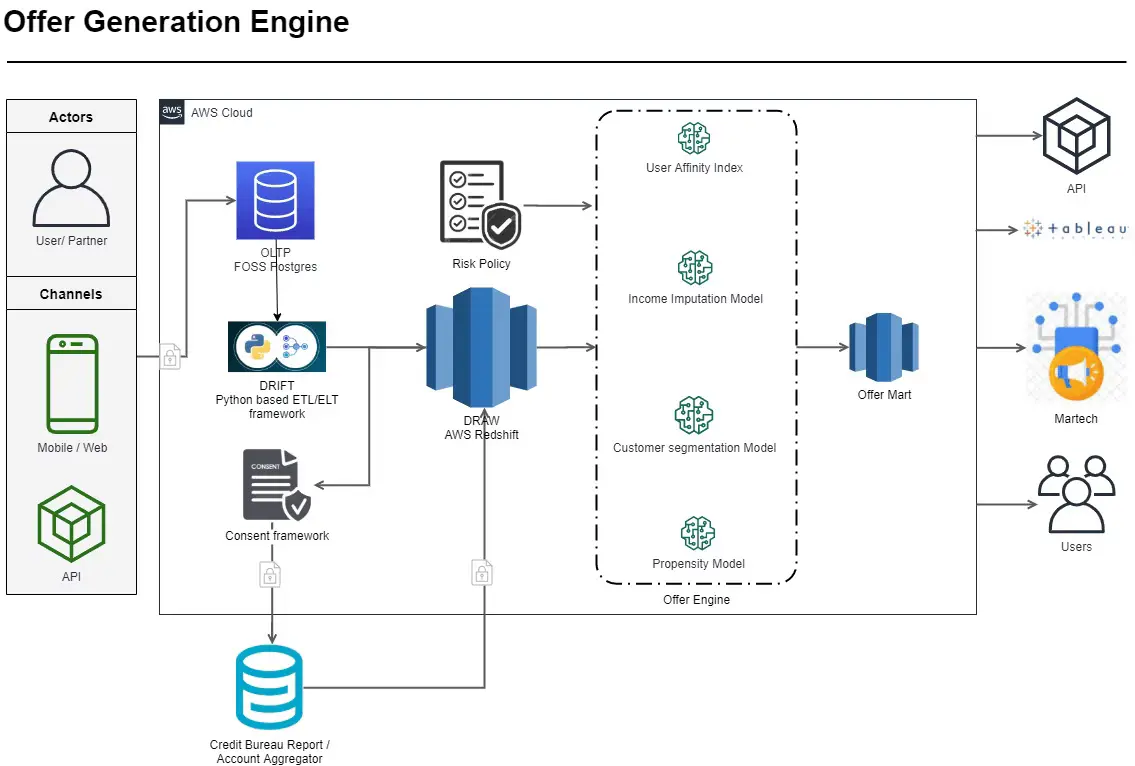
To resolve this, we developed a real-time data integration pipeline using AWS DMS (Database Migration Service) for streaming data and DRIFT, our in-house Python and SQL-based ETL tool, to merge bureau data with Account Aggregator (AA) data. Bureau data provided historical credit behavior, while AA data offered real-time transactional insights. The pipeline architecture included:
- Data source layer: Ingesting structured and semi-structured data from bureau APIs and transactional records from Account Aggregator.
- Transformation layer: Data transformed using AWS Glue with Python and SQL scripts for cleansing, normalization, and feature enrichment — deriving critical features like debt-to-income ratio, spending patterns, and savings rate.
- Data storage: Processed data stored in AWS Redshift for analytics, with Amazon DocumentDB used as a data lake and for storing partner responses.
Technical impact: data latency was reduced by 50%, enabling near real-time credit offers, and unified customer profiles enabled advanced modeling that increased offer acceptance by 30%.
What Machine Learning Models Drive Offer Precision?
NBFCs need credit offers that are relevant and personalized — precise customer segmentation, affinity scoring, and risk assessment based on each customer's actual financial behavior. Existing rule-based systems were inadequate for scaling personalization in a high-volume environment. We implemented four ML models using MLflow for model development and management:
Customer Segmentation Model
- Approach: Unsupervised learning (K-means clustering) segmented customers based on repayment history, account balance, and loan frequency.
- Technical stack: Python, AWS DMS for real-time data replication, MLflow for MLOps.
- Feature engineering: Default risk, liquidity, and monthly cash flow classified customers into high-risk, low-risk, and high-value categories.
- Impact: Improved marketing ROI by 25% through more precise, targeted offers.
User Affinity Index
- Approach: A supervised learning model (LightGBM) calculated an affinity score for each customer based on transactional patterns, prior engagements, and demographic information.
- Technical stack: Python, AWS Redshift, MLflow, and Airflow for orchestration.
- Feature engineering: Historical clickstream metrics captured digital and product preferences, combined with bureau data on existing credit product inquiries.
- Impact: Increased conversions by 15% by focusing on customers most likely to engage.
Income Imputation Model
- Approach: XGBoost imputed missing income data based on transactional patterns and derived financial indicators.
- Technical stack: Python, AWS Redshift, MLflow, and SQL for feature engineering.
- Feature engineering: Demographic, geographic, and employment-related data points, company characteristics, bureau transaction history, and current credit obligations.
- Impact: Reduced rejection rates by 18% due to more accurate income estimation.
Propensity Modeling
- Approach: A logistic regression model predicted a customer's propensity to accept specific offers based on historical engagement and financial stability.
- Technical stack: Python, AWS DMS, Airflow, and AWS Redshift for orchestration and data management.
- Feature engineering: Bureau data on minimum, maximum, and median credit balances, combined with campaign response data and clickstream events.
- Impact: Increased offer conversion rates by 25% through more personalized targeting.
How Are Offers Delivered in Real Time?
Once credit offers are generated, they need to reach customers in real time across channels like SMS, email, and WhatsApp using Martech automation. We integrated personalized credit offers with the client's Martech platform through REST APIs, built around three components:
- Offer Engine API: Developed using Python (FastAPI) and deployed on AWS EC2 behind Nginx, serving offers to the Martech platform.
- Real-time messaging pipeline: Credit offers delivered via Apache Kafka, ensuring near-instantaneous cross-channel messaging.
- Campaign monitoring: AWS Redshift and Tableau tracked response metrics, engagement rates, and conversions in real time.
Technical impact: reduced time-to-market for credit offers by 15%, and improved customer engagement with cross-channel touchpoints by 20%.
How Is Compliance Built Into the System?
NBFCs must comply with strict regulatory frameworks around data privacy, consent, fraud detection, and Do Not Disturb (DND) regulations. We built a compliance management framework as a middleware service using Python and SQL, ensuring every credit offer adhered to:
- User consent: Validated via APIs integrated with the client's consent framework.
- Blacklist and DND verification: SQL queries checked offers against preloaded blacklists and DND data sources before any offer went out.
- Fraud detection: A rule-based engine, leveraging AWS Redshift, flagged suspicious activity to prevent credit offers from being sent to high-risk profiles.
Impact: zero compliance violations, improving customer trust, and a 10% reduction in legal risk.
How Was Campaign Performance Continuously Optimized?
Campaign performance required constant optimization to maximize offer acceptance and minimize marketing spend. We built an automated campaign analysis pipeline using AWS Lambda and Redshift, where Python and SQL scripts analyzed customer engagement data to recalibrate ML models based on real-time feedback — rather than waiting for a quarterly model refresh cycle.
A/B testing identified the most effective offer types for conversion rate optimization, and the resulting insights led to a 10% reduction in marketing costs by focusing spend on high-conversion segments.
Key Takeaways
- Integrating bureau and Account Aggregator data cut latency by 50% and drove a 30% increase in offer acceptance
- Four purpose-built ML models — segmentation, affinity, income imputation, and propensity — outperformed rule-based personalization across every metric measured
- Real-time Martech integration via Kafka and FastAPI cut time-to-market for offers by 15% and lifted engagement by 20%
- Compliance checks built into the pipeline as middleware, not an afterthought, produced zero violations while reducing legal risk by 10%
- Continuous, feedback-driven model recalibration is what sustained a 10% reduction in marketing cost over time
Conclusion
This project shows the power of data integration, ML-driven analytics, and Martech automation in transforming credit offer generation. By leveraging AWS DMS, Redshift, MLflow, and in-house ETL tools like DRIFT, we improved offer acceptance by 30%, reduced rejection rates by 18%, and improved overall campaign ROI by 25% — all while maintaining full regulatory compliance. This AWS-powered architecture shows how financial institutions can harness data engineering, machine learning, and scalable cloud infrastructure to achieve strategic growth in personalized credit offerings.
This kind of personalization pipeline builds directly on the Data Lakehouse and DRIFT ETL framework described elsewhere in our engineering blog, and reflects the same data engineering discipline behind our credit product offer generation case study.
Looking to build a similarly data-driven approach to personalized credit offers? Connect with our experts to explore the right architecture for your organization.







Email: info@bajajtechai.com
Ph. No.: +91 9049001579 (Mon to Sat - 9 am to 6 pm IST)
