


Introduction Hook
Within 18 months of implementation, roughly 60% of enterprises report regretting their choice of CMS not because the platform they picked was bad, but because it wasn’t the right fit for their scale, use case, or team. A wrong pick doesn’t just mean a clunky editing experience; it means repeating a six- or seven-figure investment cycle within two years.
This blog compares four platforms enterprises evaluate most often Adobe Experience Manager (AEM), Liferay, Sanity, and Strapi using real deployments, not just feature checklists, to help decision-makers match a platform to their actual business context rather than the platform with the longest feature list.
Why Do Six in Ten Enterprises Regret Their CMS Choice?
Most failed CMS selections share a common root cause: the decision gets made on a feature matrix every platform scored against every capability rather than against the organization’s actual scale, industry constraints, and team capability. A platform can win every checkbox in a demo and still be the wrong choice if an internal team can’t sustainably operate it, or if it’s over-built for an organization’s actual content complexity.
Two structural concepts are worth defining upfront, since they shape which platform fits which organization:
- Digital Experience Platform (DXP): A CMS combined with personalization, analytics, and omnichannel delivery capabilities built for large organizations managing complex, high-traffic digital experiences across many channels.
- Headless CMS: A content backend with no built-in front-end templating content is delivered via API to whatever front-end a developer builds, giving more flexibility but requiring more engineering involvement.
Where a platform sits on this spectrum full DXP versus lightweight headless CMS is usually a better starting filter than any individual feature.
Summary: Most CMS regret comes from matching platforms to feature checklists instead of actual organizational scale and team capability not from picking an objectively bad product.
What Are the Four Platforms, and Who Are They Actually Built For?
Adobe Experience Manager (AEM)
AEM combines content management and digital asset management (DAM) into a single platform for creating, managing, and delivering content across websites, apps, and other channels. It has strong presence across BFSI, FMCG, travel, healthcare, insurance, and manufacturing, and its core strengths are faster time to market through reusable components, omnichannel delivery, AI-driven personalization, and auto-scalability for high-traffic environments.
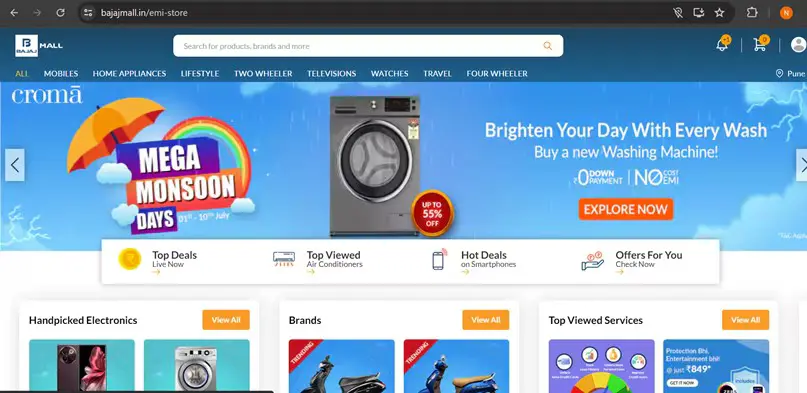
Real-world example: Bajaj Mall, Bajaj Finance’s hyperlocal e-commerce marketplace, runs on AEM. The platform now lists over 1.35 lakh SKUs across 50+ categories, supported by more than 40,000 dealers and sellers. AEM’s auto-scalability has enabled Bajaj Mall’s presence across more than 7,000 cities, while integration with Adobe Commerce has helped the platform manage over 1.27 lakh catalogues and grow its active seller base to 50,000.
Positioning: Adobe has been named a Leader in Gartner’s Magic Quadrant for Digital Experience Platforms for eight consecutive years, most recently in the 2025 report.
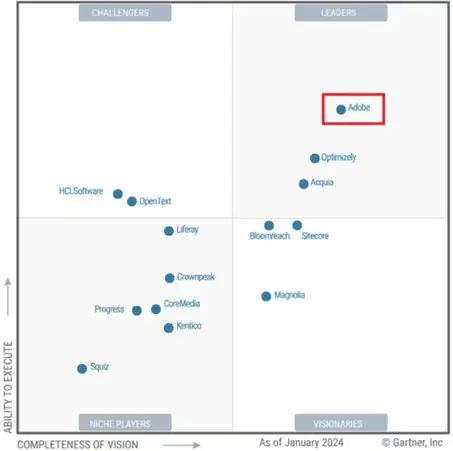
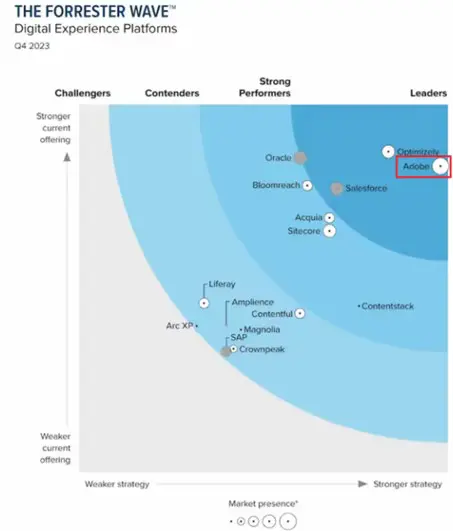
Ideal for: Large enterprises especially in regulated or high-compliance industries like BFSI, insurance, and healthcare that need a full DXP with advanced personalization, omnichannel delivery, and enterprise-grade scale, and can support the platform’s premium cost with a comprehensive implementation team.
Liferay
Liferay is a portal-centric DXP designed for organizations managing complex, authenticated digital experiences customer portals, partner extranets, and employee intranets alongside traditional content management.
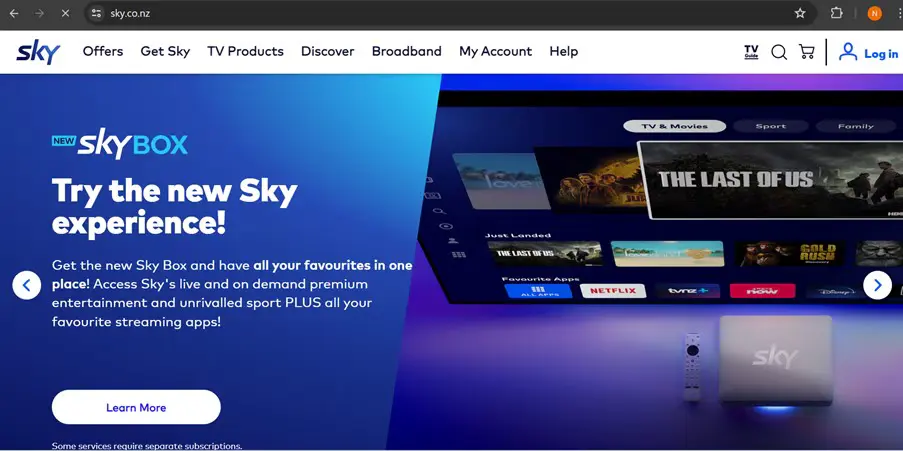
Real-world example: SkyTV, a major New Zealand broadcaster and telecom provider serving over 1 million customers, moved off an on-premises, non-scalable system to Liferay. Customer self-service increased by 140%, cart acquisition rose by 7%, and Liferay’s auto-scaling capability let SkyTV handle peak demand that its previous system couldn’t support.
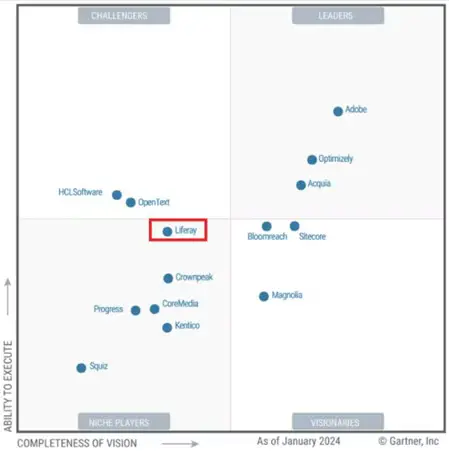
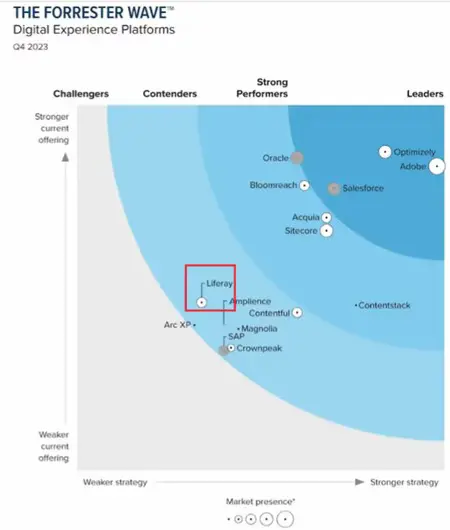
Positioning: Liferay has been recognized as a Niche Player in Gartner’s 2025 Magic Quadrant for Digital Experience Platforms, with particular strength in authenticated, portal-driven experiences.
contender among existing Digital Experience Platforms.
Ideal for: Mid-to-large organizations that need a cost-effective, highly customizable platform for complex portal use cases B2B trade portals, dealer networks, customer self-service more than a pure marketing content engine.
Sanity
Sanity is a headless, API-first CMS built around structured content and real-time collaborative editing, with an open-source, React-based editing environment and a globally distributed content backend.
Real-world example: PUMA used Sanity to build a content engine on top of Salesforce Commerce, serving as the repository for its product catalog and related content. The PUMA team has since created more than 500 category landing pages, over 4,000 hero banners, and more than 55,000 pieces of reusable content within Sanity, staging over 100 campaigns.

Positioning: Sanity isn’t currently positioned in Gartner’s or Forrester’s DXP reports it competes in the headless CMS category rather than the full DXP category but it recorded the highest satisfaction score among content platforms in the 2022 JAMstack Community Survey.
Ideal for: Small-to-mid-sized organizations and content-heavy teams particularly retail, media, and marketing organizations that want structured, reusable content and real-time collaboration without a full DXP’s overhead.
Strapi
Strapi is an open-source, API-based headless CMS built for teams that want direct control over their content model and delivery layer, with a plugin ecosystem and support for multiple databases.
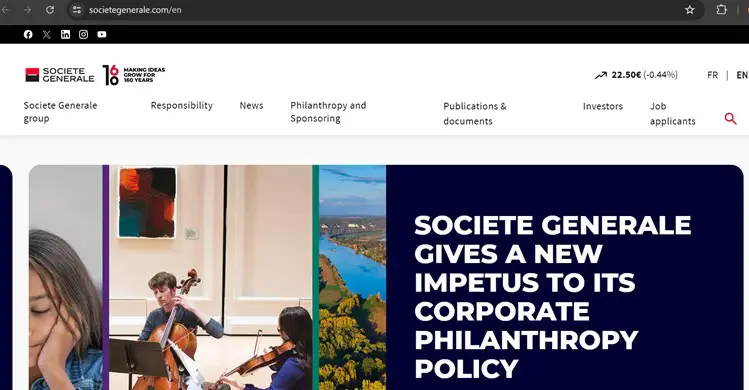
Real-world example: Societe Generale needed to launch a fully functional training site within a few months. Strapi’s ease of setup and customization let the team build and launch the site quickly, without the longer implementation timeline a full DXP would typically require.
Positioning: Like Sanity, Strapi is not currently featured in Gartner’s or Forrester’s DXP reports, reflecting its position as a developer-focused headless CMS rather than a full digital experience platform.
Ideal for: Small-to-mid-sized projects and developer-led teams that need fast implementation, tight control over the API layer, and lower upfront cost, with enterprise support available for larger paid deployments.
How Should You Actually Decide Between Them?
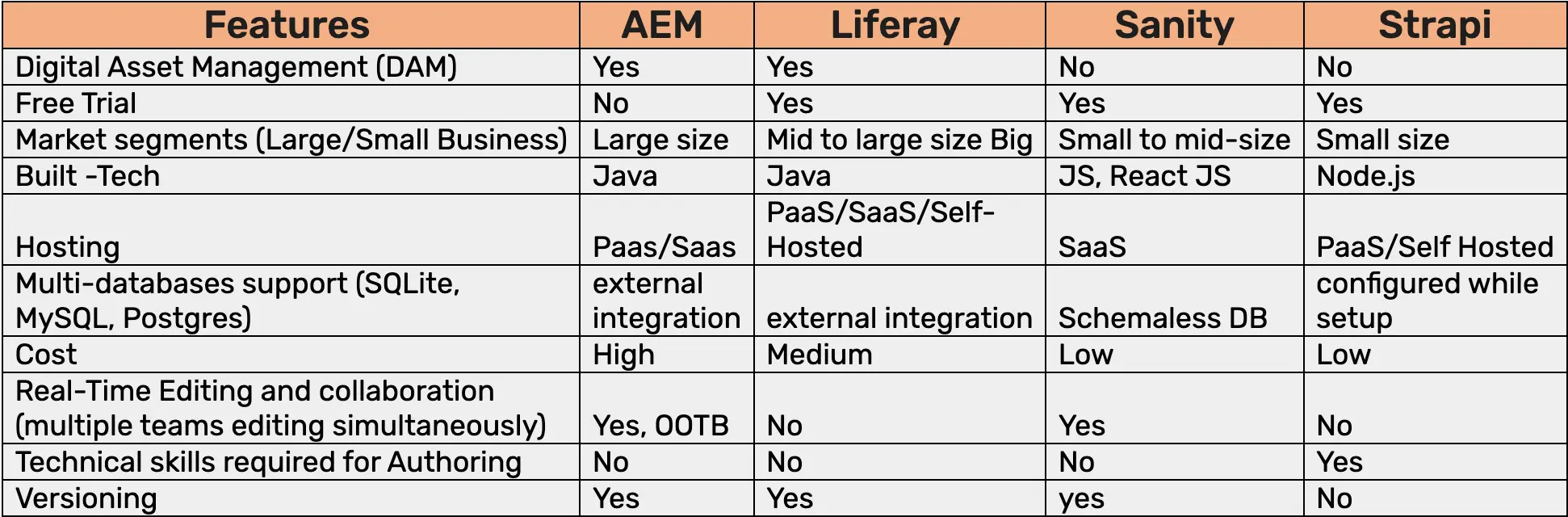
Once the category fits, three questions should narrow the final decision:
- What’s the actual content complexity? A high volume of interconnected content types, personalization rules, and channels points toward a full DXP (AEM or Liferay). Simpler, catalog- or campaign-style content points toward a headless CMS (Sanity or Strapi).
- What compliance and governance requirements apply? Regulated industries with strict data governance and audit requirements are usually better served by AEM or Liferay’s more comprehensive, enterprise-grade governance tooling.
- What’s the internal team’s engineering capacity? Headless platforms like Sanity and Strapi require more front-end engineering investment to build the delivery layer; full DXPs like AEM and Liferay include more of that out of the box, at a higher licensing cost.
At Bajaj Tech.AI, this is exactly the kind of decision we help clients work through including our own experience running Bajaj Mall on AEM at scale mapping platform category, compliance needs, and team capacity before recommending a specific product, rather than starting from a feature comparison sheet.
Summary: The right CMS choice starts with matching platform category (full DXP vs. headless) to content complexity, compliance needs, and internal engineering capacity — not with comparing feature lists across all four platforms equally.
Key Takeaways
- Roughly 60% of enterprises regret their CMS choice within 18 months, usually because the decision was made on features rather than fit.
- AEM and Liferay are full DXPs built for large-scale, complex, often regulated environments; Sanity and Strapi are headless CMS platforms built for content-heavy or developer-led teams that need speed and flexibility.
- Real deployments back this up: AEM supports Bajaj Mall’s 1.35 lakh+ SKU marketplace, Liferay lifted SkyTV’s self-service by 140%, Sanity powers PUMA’s content operations at scale, and Strapi got Societe Generale’s training site live in months.
- Compliance and governance requirements, not just cost, should weigh heavily for regulated industries choosing between these platforms.
- Internal engineering capacity is a deciding factor: headless platforms shift more delivery-layer work onto your team; full DXPs include more of it, at a higher cost.
Conclusion
There’s no single “best” CMS only the platform that fits an organization’s scale, compliance requirements, and internal capability. The enterprises that avoid the 18-month regret cycle are the ones that start from their own constraints and use cases, then map platforms against them, rather than starting from a vendor comparison chart and working backward. AEM, Liferay, Sanity, and Strapi each solve a genuinely different problem the right choice depends entirely on which problem your organization actually has.
Weighing CMS or DXP options for your organization? Connect with our experts to map the right platform against your scale, compliance needs, and team capacity.






Email: info@bajajtechai.com
Ph. No.: +91 9049001579 (Mon to Sat - 9 am to 6 pm IST)
