


When Salesforce handles customer-facing orders and MySQL tracks backend inventory, the two systems need to agree on product quantities at all times or a business risks overselling stock that no longer exists. Integrating Salesforce and MySQL via MuleSoft is a proven way to solve this: Salesforce serves as the user interface for handling customer orders, MySQL acts as the database tracking product quantities, and MuleSoft serves as the middleware connecting the two and keeping them synchronized in real time.
This kind of integration matters most for businesses managing physical or limited inventory through a Salesforce-based sales process, the moment order volume grows past what manual reconciliation can handle, real-time synchronization stops being a nice-to-have and becomes operationally necessary.
Real-time inventory sync isn't really a data problem, it's a middleware problem, and the middleware layer is where most of the actual engineering work lives.
How Does the Integration Work at a High Level?
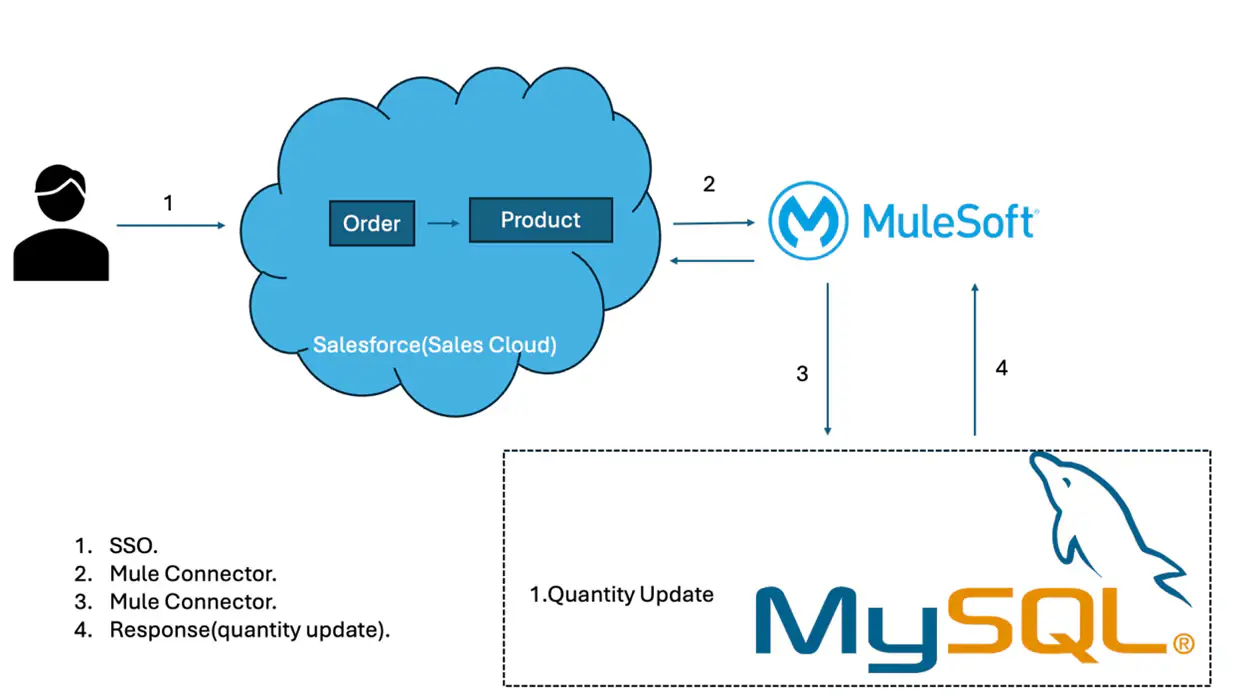
When a customer places an order in Salesforce, the corresponding quantity of the ordered product is automatically decreased in the MySQL database. Conversely, when an order is cancelled, the product quantity is restored. This real-time data synchronization guarantees that inventory levels in MySQL accurately reflect the current state of customer orders at any given moment.
What Are the Real Challenges in This Kind of Integration?
Data Synchronization Complexity
Ensuring data between Salesforce and MySQL stays synchronized is a primary challenge. Salesforce operates as a CRM handling orders and customer data, while MySQL manages the backend inventory database. Any delay in synchronization can lead to discrepancies, such as overselling products that are no longer in stock, a problem that damages customer trust the moment it happens, regardless of how quickly it's corrected afterward.
MuleSoft handles this by providing an API-led connectivity approach leveraging real-time data integration capabilities to ensure immediate synchronization between the two systems, reducing the risk of mismatched data.
Handling Bulk Orders
Processing bulk orders or cancellations can be resource-intensive and time-consuming, and bulk updates to a large MySQL database can strain the system if not handled carefully.
Batch processing through MuleSoft lets the integration handle bulk data transfers more efficiently, ensuring that even large volumes of orders are processed without causing system downtime.
Error Handling
If an error occurs during integration such as a failed order update in MySQL, it can create data inconsistencies affecting both the Salesforce UI and the backend database.
MuleSoft offers robust error handling, letting administrators identify and resolve issues promptly, along with retry mechanisms that ensure failed transactions are retried and completed successfully maintaining data integrity across both systems.
Each challenge here maps to a specific MuleSoft capability API-led connectivity for synchronization, batch processing for volume, and retry logic for errors which is what makes MuleSoft a natural fit for this kind of integration rather than a generic point-to-point connector.
What Are the Business Benefits of This Integration?
- Real-time inventory management: As soon as an order is placed or cancelled in Salesforce, MySQL reflects the change immediately, reducing the risk of overselling or stockouts and ensuring the business always has accurate stock information.
- Enhanced customer experience: With accurate product availability displayed in Salesforce, customers see up-to-date inventory information, preventing orders for out-of-stock items and improving trust in the business.
- Scalability: The integration scales as business operations grow whether handling a small number of daily orders or thousands, MuleSoft ensures data between Salesforce and MySQL remains synchronized without bottlenecks.
How Is the Solution Actually Implemented?
- Salesforce as the frontend: Salesforce serves as the primary user or agent interface where orders are created, modified, or cancelled through a customizable UI.
- MuleSoft as the integration platform: MuleSoft operates as middleware, handling data transfer between Salesforce and MySQL. When an order is placed or cancelled, MuleSoft triggers the appropriate API calls to MySQL, updating product quantity accordingly, and handles any necessary data transformations along the way.
- MySQL as the backend: MySQL stores product inventories. When an order is placed, MuleSoft decreases the product quantity in MySQL; when cancelled, the product count is restored.
- Error handling and transaction management: MuleSoft's error-handling capabilities ensure failed transactions are retried or rolled back to avoid inconsistencies, with logs generated and alerts sent to administrators for manual intervention when necessary.
Key Takeaways
- Real-time synchronization between a CRM and a backend database prevents overselling and stockout situations before they reach the customer
- MuleSoft's API-led connectivity, batch processing, and retry mechanisms map directly to the three hardest problems in this kind of integration
- Scalability isn't an afterthought, the same architecture handles a handful of daily orders or thousands without redesign
- Robust error handling and transaction logging are what let a business trust an automated integration without manual double-checking
- This kind of middleware integration reflects the same CRM and systems-integration discipline behind Bajaj Tech.AI's broader Salesforce engineering work
Conclusion
Integrating Salesforce with MySQL via MuleSoft offers a seamless way to manage order and inventory processes efficiently, ensuring product quantities update in real time and provide accurate stock levels for both internal teams and customers. While challenges like synchronization, bulk processing, and error handling are real, MuleSoft's capabilities directly address each one. The result is enhanced operational efficiency, improved customer satisfaction, and the ability to scale without worrying about system performance automating key processes that would otherwise demand constant manual reconciliation.
Looking to keep your CRM and backend systems perfectly in sync? Connect with our experts to explore the right integration approach for your business.







Email: info@bajajtechai.com
Ph. No.: +91 9049001579 (Mon to Sat - 9 am to 6 pm IST)
