


Summary
Investors frequently forget to complete the final step of SIP (Systematic Investment Plan) registration, submitting their Unique Registration Number (URN) on their bank's portal to set up an auto-debit mandate leading to SIP termination and lost revenue. This gap sits at an easy-to-overlook point in the customer journey: the investor has already made the decision to invest, but the technical last step happens on a separate platform the organization doesn't directly control.
Bajaj Tech.AI built the ISIP Calling Module, which automatically creates a follow-up task the moment a SIP is registered, assigns it to a Virtual Business In-Charge (VBIC) team member in round-robin fashion, and tracks completion through daily automated reporting helping the organization prevent SIP terminations through timely, proactive investor outreach.
Business Challenge
One of the critical pain points was that many investors failed to complete the final step of SIP registration submitting their URN on their respective bank's portal to set up an auto-debit mandate. Without that final step, a registered SIP would ultimately terminate, representing both a lost investment opportunity for the customer and lost revenue for the organization, even though the investor's original intent to invest had already been captured.
The organization needed a system to:
- Ensure timely follow-up with investors who had registered for a SIP
- Assign tasks efficiently to the Virtual Business In-Charge (VBIC) team responsible for managing these follow-ups
- Generate accurate reports on pending and completed tasks to monitor performance and prevent SIP termination
The problem wasn't investor intent, most investors who registered for a SIP genuinely wanted to invest. It was that a single missed administrative step, with no system prompting a follow-up, was enough to quietly derail the entire investment.
Solution Approach
The ISIP Calling Module automated the process of reminding investors to complete their SIP registration on their bank's portal, built around three key personas: the Virtual Business In-Charge, responsible for calling the investor and accessing account details like phone number; the Process Owner (VBIC), who receives generated reports to monitor task status and address delays; and the Investor, who invests in the SIP and for whom a URN is generated. Each persona's role was deliberately narrow, which is what kept the process simple enough to actually run reliably at scale.
The following swim lane diagram illustrates the interactions and responsibilities among the Actors at each stage of the process:
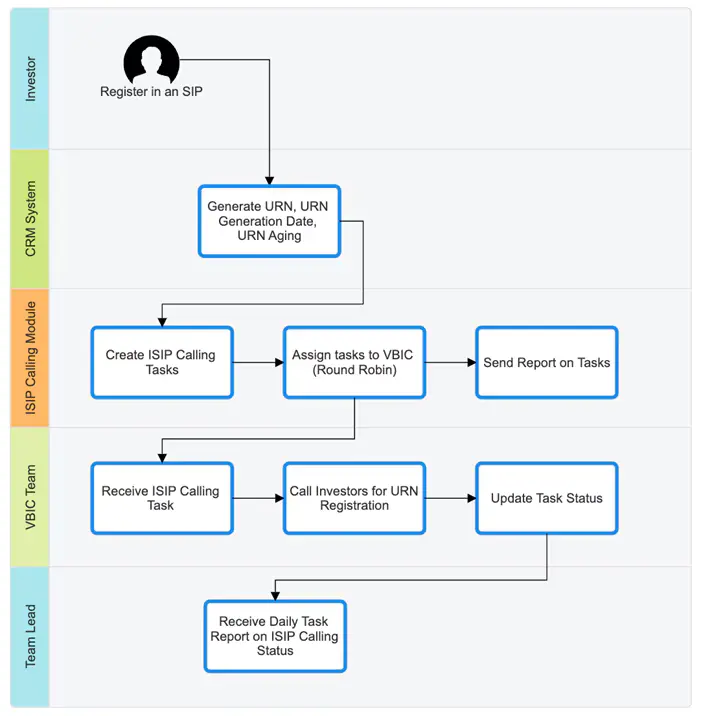
- URN tracking: Once a SIP is registered in the system, a URN number is generated along with the URN Registration Date, giving the system a clear trigger point.
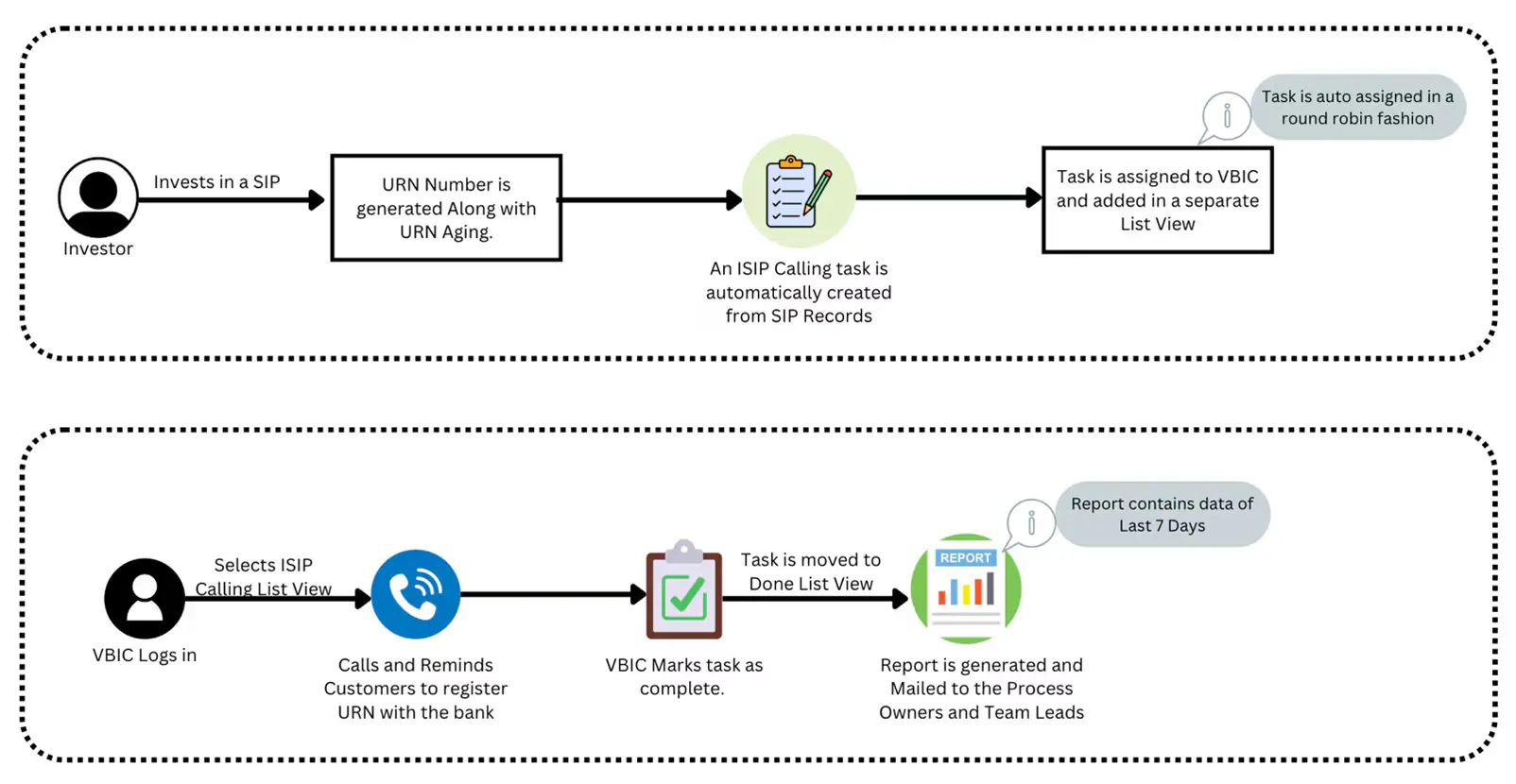
- Automated task creation: A new ‘ISIP Calling’ task is automatically created for each registered SIP, linked to the corresponding investor and assigned to a VBIC, no manual task creation required.
- Round-robin task assignment: The system assigns these tasks to the VBIC team in a round-robin fashion, ensuring equal distribution of tasks and efficient workflow management.
- Task reminders: VBICs are responsible for calling investors and reminding them to register their URN details on their bank's portal within a stipulated 7-day window.
- Daily reporting: A report of all pending and completed ‘ISIP Calling’ tasks is generated daily and emailed to VBIC Team Leads and Process Owners, ensuring task status is monitored and delays are addressed immediately.
The round-robin assignment logic matters as much as the reminder itself without it, task load across the VBIC team would have been uneven, and some investors would inevitably fall through the cracks.
How this solution works :
Business Impact & Results
- Increased efficiency: Round-robin task assignment ensured equal workload distribution among VBICs, reducing manual task management significantly.
- Higher investor engagement: Timely follow-up with investors resulted in higher completion rates for SIP registrations, significantly reducing SIP terminations caused by incomplete mandates.
- Improved reporting: Automated daily reports let team leaders closely monitor the progress of ISIP Calling tasks, ensuring all SIPs were processed on time.
- Reduced losses: By ensuring investors completed URN registration within the 7-day window, the institution mitigated potential revenue loss from terminated SIPs.
The implementation streamlined the entire SIP registration and follow-up process, resulting in higher investor satisfaction, more efficient task management, and reduced financial losses, all from automating a single, easy-to-miss administrative step.
Key Takeaways
- A single unfinished administrative step, URN registration was enough to silently terminate an otherwise completed SIP investment
- Automated task creation removes the dependency on someone remembering to follow up manually
- Round-robin assignment is what keeps a follow-up workload evenly distributed as investor volume scales
- Daily automated reporting gives team leads the visibility needed to catch delays before they become terminations
- This same proactive, automated follow-up discipline underpins Bajaj Tech.AI's approach to dealer renewal management and other customer lifecycle workflows
Conclusion
The implementation of the ISIP Calling Module streamlined the entire process of SIP registration and follow-up, resulting in increased investor satisfaction, efficient task management, and reduced financial losses for the organization. Financial institutions facing similar drop-off at a critical final step whether in investments, lending, or any process with a time-bound administrative requirement can draw a direct lesson from this engagement: automating the follow-up trigger, rather than relying on manual tracking, is often the single highest-leverage fix available.
This kind of proactive CRM automation reflects the same discipline behind Bajaj Tech.AI's transaction mapping and dealer renewal engagements removing the manual step that most often causes a process to quietly fail.
Looking to solve a similar business challenge? Connect with our experts to explore the right solution for your organization.







Email: info@bajajtechai.com
Ph. No.: +91 9049001579 (Mon to Sat - 9 am to 6 pm IST)
