

Summary
A business selling considered-purchase products had built a competent digital journey and was losing most of the people who entered it. Customers browsed, searched, compared specifications, struggled to understand which option applied to their situation, and left. The journey worked for people who already knew what they wanted. Everyone else abandoned partway.
The measurable loss was conversion. The larger loss was that abandonment produced nothing at all. A customer who uploaded documents, answered profile questions and compared two products before hesitating had demonstrated more qualified intent than most inbound enquiries, and generated no lead, no record and no follow-up. That intent evaporated.
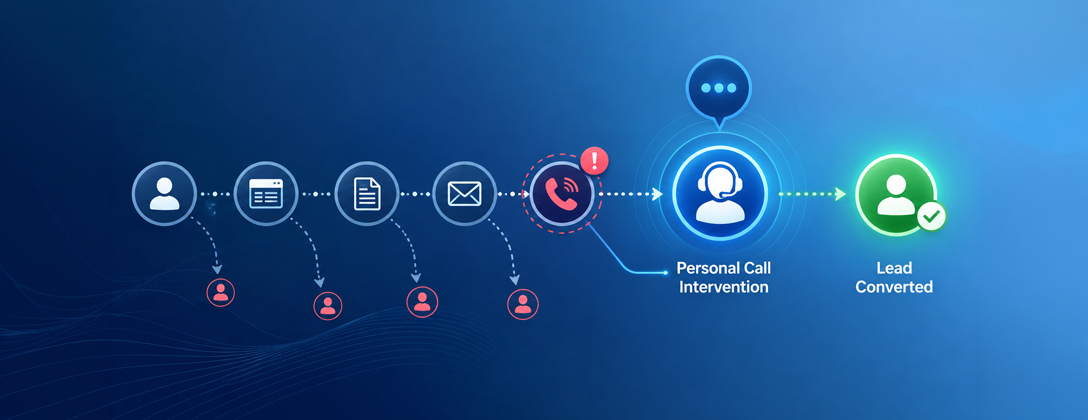
We built a conversational discovery journey that captures documents, computes a profile, recommends against it, explains the recommendation in language a person can act on, and carries the customer through to a structured purchase. The part that changed the economics was the last agent in the chain: when the system cannot convert, it writes the lead to the existing CRM with the full conversation attached, so a human picks up a conversation in progress rather than making a cold call.
Business Challenge
Summary: Customers were abandoning high-consideration journeys midway, and abandonment produced no lead, no context and no follow-up, so demonstrated intent was lost entirely.
The journey was fragmented by design, not by neglect
Discovery ran across catalog browsing, search, specification review, product selection and checkout. Each step had been built well in isolation. Together they asked a customer to hold a growing amount of context in their head while navigating rigid filters and forms.
That structure works for a customer who arrives knowing what they want. For a considered purchase, most customers do not. They arrive with a situation and need help translating it into a product.
The language problem
Product descriptions were written in the vocabulary of the people who build the products. Customers were being asked to distinguish between options whose differences were expressed in terms they had no reason to understand, then commit money to that judgment.
Faced with a choice they cannot confidently evaluate, most people do not guess. They leave and intend to come back, and mostly they do not.
Manual, repetitive information capture
Profile information was collected through forms. Supporting documents were uploaded separately and processed later, which meant the customer supplied information the system already had in a document sitting in the same session. Every additional field was another place to stop.
The failure that mattered most
When a customer hesitated, raised a question outside what the site could answer, or showed intent to leave, nothing happened. No lead was created. No context was retained. The sales team never learned that a qualified prospect had spent eleven minutes comparing two products and left at the final step.
This is the part worth sitting with. The people abandoning halfway are, on average, more qualified than the people filling in a contact form, because they have already invested effort and disclosed their situation. They were the most valuable audience on the site and the only one receiving no follow-up whatsoever.
Returning customers started from zero
A customer who came back a week later was treated as a stranger. Previous documents, computed profile, prior comparisons, all gone. The second visit was as effortful as the first, which is a reliable way to lose someone twice.
Solution Approach
Summary: Four agents across one conversation. Document intelligence, guided recommendation, structured purchase, and lead capture with full context when conversion is not possible.
Agent 1. Document intelligence
The customer uploads relevant documents inside the conversation rather than through a separate flow. Vision processing extracts the data points, a structured domain knowledge base supplies the interpretation, and the required profile attributes are computed from what the document already contains.
This removes the largest block of manual entry. The customer stops being asked for information they have already provided in another form.
One boundary stated honestly: extraction accuracy depends on document quality, and handwritten documents are out of scope. Say this before implementation rather than discovering it during acceptance testing.
Agent 2. Product advisor
Recommendations are generated by interpreting the computed profile against product attributes and recommendation rules held in a structured knowledge base, then explained in plain language.
The explanation carries as much weight as the recommendation. Telling a customer which product suits them is not persuasive on its own. Telling them which of their circumstances made it the right one is, because it demonstrates the recommendation was made about them specifically.
Agent 3. Comparison and purchase workflow
The customer finalises through a guided conversational comparison. The system consolidates the selected product details, captures required purchase information, and generates a structured purchase workflow that downstream commerce and fulfilment systems can consume directly.
Output is structured rather than conversational at this boundary, which is what makes the handoff to existing systems clean rather than another integration project.
Agent 4. Lead capture and CRM handoff
Every conversation is treated as a lead opportunity, and intent is evaluated continuously rather than at the end.
Where the system can guide the customer to a confirmed selection, the lead converts inside the conversation. Where it cannot, because the customer hesitates, raises something beyond scope, shows intent to leave, or simply asks for a person, the lead is written to the existing CRM through standard connectors with the full conversation context and computed profile attached.
The calling team then approaches someone whose situation, documents, comparison set and hesitation point are all visible. They open with the question the customer stopped on rather than with an introduction.
The memory layer
Within a session, context holds across turns. The current conversation, uploaded documents and the active comparison stay live, so the customer never repeats themselves.
Across sessions, a persistent store holds the customer profile, preferences and prior interactions. A returning customer is recognised, their previous comparison is available, and recommendations account for what they have already looked at and rejected.
Both layers enrich the CRM record. This is the detail that changes what a follow-up call feels like. The human agent is not working from a name and a timestamp. They have the whole history.
Guardrails and boundaries
Recommendations are grounded in the structured product knowledge base rather than generated freely, so the system cannot invent product attributes or terms. Where a question falls outside the defined product set, the correct behavior is to capture the lead and route to a person, not to improvise.
Business Impact & Results
Summary: Abandonment converts from total loss into a qualified lead with full context, and the constraint moves from lead generation to calling capacity.
The value driver, with visible inputs
The primary value is not incremental conversion. It is the recovery of intent that currently produces nothing.
Input
Where it comes from
Journeys started per month
Client analytics
Share reaching qualified intent, meaning profile captured or comparison started
Client analytics
Share of those currently abandoning with no lead created
Usually close to all of them
Share the calling team has capacity to work
Client sales operations
Close rate on a warm, context-carrying follow-up
Client, or measured in pilot
Margin per sale
Client finance
Recovered value is the product of those six numbers. Every one of them belongs to the client, which is why the model survives scrutiny in a way that a headline percentage does not.
The constraint is calling capacity, not lead capture
This is the honest limit, and it should be raised early. Capturing more leads than the sales team can contact is a reporting improvement rather than a revenue one. The binding constraint in almost every deployment is how many follow-ups the human team can make in a week.
Two consequences follow. First, lead scoring matters immediately rather than eventually, because the team needs the best leads first. Second, once capture volume exceeds calling capacity, the next investment is expanding the qualification leg of outbound rather than capturing more.
What becomes measurable
Where journeys stall, by step, which converts drop-off from an aggregate number into a specific defect. Which product explanations precede abandonment, which is a content problem the merchandising team can fix without engineering. Extraction accuracy by document type. Close rate on context-carrying follow-ups compared with cold ones, which is the number that justifies the whole lead capture layer. Recognition and conversion rates for returning customers, which is where the persistent memory earns its cost.
What compounds
Every conversation improves the profile store. Returning customers are recognised, their rejected options are known, and recommendations narrow rather than restart. This is slow-building and difficult to attribute in the first quarter, which is exactly why it should be instrumented from day one rather than claimed later.
An honest note on scope
In accelerator scope, order management, fulfilment and payment integration are simulated, and CRM integration is demonstrated against a representative instance. Connectors for production systems are configured during full implementation. Multi-language and voice are not included. State this in the proposal.
Key Takeaways
- The people abandoning halfway are your most qualified audience. They have invested effort and disclosed their situation. In most journeys they are also the only audience receiving no follow-up at all.
- Explaining the recommendation matters more than making it. Naming which of the customer's circumstances drove the answer is what makes it credible. A confident recommendation with no reasoning reads as a sales tactic.
- A warm handoff is a different product from a lead record. A name and a timestamp produces a cold call. A conversation, a computed profile and a visible hesitation point produces a continuation.
- Capturing more leads than you can call is not revenue. Calling capacity is the binding constraint. Score leads from the start and expand outbound capacity before expanding capture.
- Cross-session memory is what makes the second visit cheaper than the first. Without it, a returning customer repeats the entire journey, which is how you lose the same person twice.
Conclusion
Most work on digital discovery journeys aims at the completion rate, and that is a reasonable place to spend effort. It also concedes the larger loss without examining it. In a considered purchase, the majority of people who enter will not finish in one visit, and no amount of interface refinement changes that. It is the nature of buying something complicated.
The question worth asking is what happens to those people. In most organizations the answer is nothing. They leave, the session ends, and the most qualified audience on the site returns to being anonymous traffic. Treating that as inevitable is a choice, and it is usually an unexamined one.
Any business selling products that require explanation will recognize the pattern. Journeys built for customers who already know what they want, product language written by the people who build the products, and an abandonment rate everyone has learned to accept as the cost of doing business. The remedy has two halves. Make the journey conversational so fewer people need to abandon, and make abandonment productive so the ones who do are worth following up.
The second half is usually where the money is, and it is almost always the half nobody has built.
Looking to solve a similar business challenge? Connect with our experts to explore the right solution for your organization.
Worth checking this week: among the customers who abandoned your journey last month after sharing some information about themselves, how many turned into a lead record your sales team could actually work? For most organizations, the honest answer is zero. That gap is your opportunity.






Email: info@bajajtechai.com
Ph. No.: +91 9049001579 (Mon to Sat - 9 am to 6 pm IST)
