

Summary
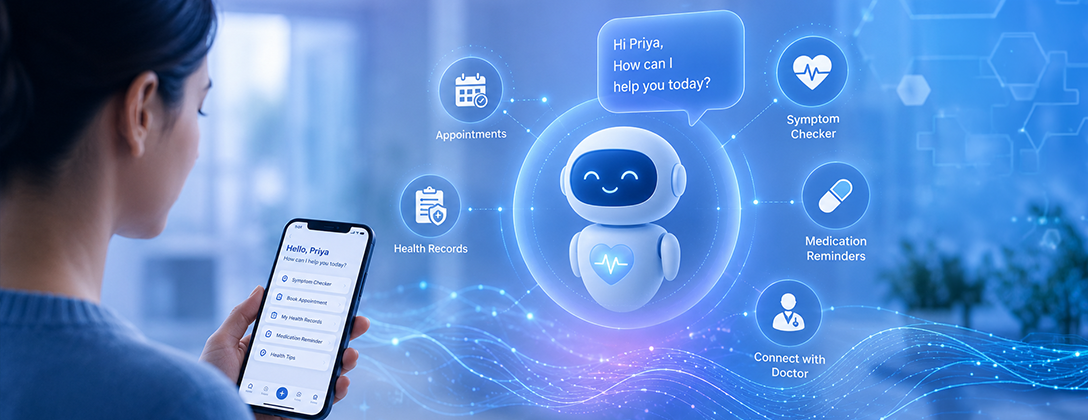
A healthcare provider wanted to simplify the patient journey across symptom discovery, diagnostics, treatment and medication. The journey was fragmented across appointment booking, lab systems, prescriptions, pharmacy and specialist consultation, and patients were navigating it without the vocabulary to do so. They could not reliably tell which specialist their symptoms pointed toward, could not interpret their own lab results, and lost continuity between one step and the next.
The obvious application of conversational AI here is also the dangerous one. A system that listens to symptoms and responds with a probable condition is a liability, regardless of how accurate it is, because it changes what the interaction is and who is accountable for it.
We built the boundary first and the capability afterwards. The system collects symptoms, maps them to relevant medical specialties, extracts and simplifies lab reports, categorises risk, interprets prescriptions against a licensed drug reference, and books appointments. It does not diagnose. Final diagnosis and treatment decisions remain with healthcare professionals, and the architecture enforces that rather than relying on prompt instructions to discourage it.
Business Challenge
Summary: Patients were navigating a fragmented care journey without the vocabulary to route themselves correctly, and every wrong turn cost time that mattered clinically.
The journey was assembled from separate systems
Appointment booking, laboratory results, prescriptions, pharmacy fulfilment and specialist consultation each functioned. None of them handed off to the next. A patient moving through care was the integration layer, carrying context between systems that did not speak to each other.
Patients cannot route themselves, and the system assumed they could
Selecting a specialist requires knowing which specialty treats your symptoms. That is clinical knowledge, and asking a patient to supply it at the point of booking puts the least informed participant in charge of the most consequential decision in the pathway.
The result was predictable. Patients chose by guesswork, by proximity, or by whichever specialty had earlier availability. Wrong routing meant a consultation that produced a referral rather than care, and the clock restarted.
Lab results arrived without interpretation
Patients received results formatted for clinicians. Reference ranges, abbreviations, parameters with no indication of which mattered. The two common responses were both bad: alarm at a marginal value, or dismissal of something that warranted attention. Both produce an appointment at the wrong time. Too early wastes a slot. Too late costs considerably more than a slot.
Continuity broke between steps
Nothing carried forward. A patient who had described symptoms, uploaded a report and been routed to a specialty arrived at the appointment with none of that visible. The clinician started from the beginning, which consumed consultation time that should have gone to care.
The cost of a dropped journey is different here
In commerce, an abandoned journey is a lost sale. In healthcare, a patient who gives up on navigating the system does not stop being a patient. They present later, in a more acute state, through a more expensive route, having had a worse outcome in the interim.
This is why access and continuity metrics matter more than cost metrics in this domain, and why a business case built only on operational savings misrepresents the value.
Why a general-purpose assistant was not an option
A conversational model asked about symptoms will produce a plausible-sounding assessment. It will do so confidently, without calibration, and without any of the context a clinician would insist on. Occasionally it will be right, which is worse, because it establishes a pattern of trust that fails without warning.
The design question was never whether the model could produce clinical text. It was how to build a system that is structurally incapable of doing so while still being useful.
Solution Approach
Summary: Define the clinical boundary first, then build routing, interpretation and booking inside it, with every recommendation traceable to its source.
Step 1. Establish what the system will never do
Before any capability was designed, the boundary was fixed. The system does not diagnose. It does not recommend treatment. It does not assess whether a symptom is urgent in the way a clinician would. Final diagnosis and treatment decisions remain under healthcare professional supervision.
This is enforced structurally rather than through instruction. Outputs are constrained to defined types: a specialty mapping, a risk category, a simplified explanation of a value, a booking action. There is no output path that produces a diagnosis, so no prompt can elicit one.
Building the boundary in the architecture rather than the prompt is the entire difference between a system that passes clinical review and one that does not.
Step 2. Symptom triage and specialty routing
Patients describe symptoms in their own words, conversationally, without being forced into a checklist. The system analyses what was reported to identify potentially relevant medical specialties and care pathways, then supports booking against that mapping.
The output is a specialty, not a condition. That distinction sounds semantic and is not. Mapping abdominal symptoms to gastroenterology is a routing decision, and routing decisions are reversible by the clinician who receives the patient. Naming a condition is a clinical act.
Where symptoms are ambiguous or map to several specialties, the system presents the options with the reasoning rather than picking one. Forced confidence is the failure mode to design against.
Step 3. Laboratory report interpretation
Patients upload reports. Vision-based extraction pulls the clinical parameters, abnormal indicators are identified against reference ranges, and the report is explained in language the patient can act on. Results are categorised by risk, and where the pattern indicates it, the relevant specialty is suggested with booking available.
Risk categorisation is not diagnosis, and the interface is built to keep that visible. A flagged parameter means this warrants professional attention sooner rather than later. It does not mean anything about cause.
Step 4. Prescription interpretation
Prescriptions are read using vision extraction against a licensed drug reference from a recognised health institution. The patient gets a plain-language account of what has been prescribed.
The drug reference is deliberately external and licensed rather than model knowledge. Medication information is exactly the category where a model's recall is least acceptable as a source.
Step 5. Booking and continuity
Specialty routing connects to healthcare centre discovery and appointment booking, so the pathway completes rather than terminating in advice. Context gathered along the way carries forward, so the clinician receives a patient whose reported symptoms, extracted results and routing rationale are already visible.
Cross-cutting controls
Protected health information masked before inference. Identifiers are extracted and masked at ingress so the model operates on clinical content without the patient identity attached.
Explainable retrieval. Every recommendation traces to the source that produced it. When a clinician asks why a patient was routed to a particular specialty, the answer is the retrieved reference and its confidence, not a similarity score. In a regulated review, similarity is not a reason.
Complete audit trail. Every symptom capture, extraction, risk categorisation, routing decision and booking is logged with its reasoning and retained.
Human escalation as a designed path. Ambiguity, low confidence, or any indication the interaction has moved beyond scope routes to a person with the full context attached, rather than the system continuing at reduced confidence.
Role-based access. What is retrievable and visible varies by who is asking, enforced at query time.
Business Impact & Results
Summary: The value is measured in access and continuity, with cost as support. A business case built the other way around does not survive clinical review.
What improves, and how to measure it
Outcome
Measure
Correct routing at first attempt
Share of consultations that proceed to care rather than producing a referral onward
Time to appropriate specialist
Days from first contact to the consultation that addresses the issue
Appointment timing
Reduction in consultations occurring too early or too late relative to result urgency
Consultation efficiency
Clinician minutes recovered from history-gathering already captured digitally
Continuity
Share of pathways completed without the patient re-entering at the start
Patient comprehension
Whether patients can state what their result means and what happens next
The cost case, stated honestly
Implementation and run costs are the highest of our accelerators, because compliance review, secured infrastructure and clinical validation are non-negotiable rather than optional. At mid-market patient volumes, cost avoidance alone produces a two to three year payback.
What is genuinely quantifiable: rework avoided when routing is correct at the first attempt, coordinator time released, and reduced repeat contacts. Each needs a client-supplied unit cost, and each should be modeled with visible inputs.
What is real and should not be converted into invented dollars: time to specialist access, care continuity, patient comprehension and reported experience. Present these as outcome measures in their own right. Attaching a fabricated financial value to a clinical outcome is the fastest way to lose a clinical audience.
Build the business case on access and continuity with cost as supporting evidence, and it survives the committee. Build it the other way around and it will not, correctly.
What becomes measurable that was not before
Which symptom descriptions produce ambiguous routing, which identifies where the specialty mapping needs clinical review. Extraction accuracy by report type and format. Where patients abandon the pathway, by step. Which explanations fail to land, measured by patients who re-ask the same question in different words.
That last signal is unusually useful. It marks the exact points where medical language is failing patients, which is a content problem clinicians can fix directly.
Scope boundaries to state in the proposal
The knowledge base covers a defined set of specialties and pathways. Extraction accuracy depends on document quality, and handwritten documents are out of scope. Integration with clinical systems is configured during full implementation.
Key Takeaways
- The refusal is the product. A system that maps symptoms to a specialty is useful and safe. One that names a condition is a liability, however accurate. Fix the boundary before designing the capability.
- Enforce boundaries in architecture, not in prompts. If there is no output path that produces a diagnosis, no prompt can elicit one. Instructions discourage behavior; structure prevents it.
- Routing decisions are reversible, clinical decisions are not. That asymmetry is what makes specialty mapping an appropriate use of AI in a care pathway and diagnosis an inappropriate one.
- Similarity is not a reason. When a clinician asks why a patient was routed somewhere, the answer must be a traceable source with a confidence value, not a vector distance.
- Do not price clinical outcomes you cannot measure. Access and continuity are the value. Assigning invented dollar figures to them loses the audience that has to approve the project.
Conclusion
Most conversation about AI in healthcare is about capability, and capability is not the constraint. Models can produce fluent clinical-sounding text, which is precisely the problem. The constraint is building a system that remains useful while being structurally unable to do the thing it would otherwise do easily and dangerously.
That design work is unglamorous and it is where the entire project succeeds or fails. Constrained output types instead of open generation. Specialty mapping instead of condition naming. Risk categorisation with the limits visible. A licensed reference for medication rather than model recall. Traceable retrieval so any recommendation can be examined by the clinician who receives its consequences.
Any provider running a fragmented pathway will recognize the shape of the problem. Patients asked to route themselves using knowledge they do not have, results delivered in a language written for someone else, and continuity that breaks at every system boundary. These are solvable, and solving them does not require the system to make a single clinical judgment.
Decide what the system will never do, then build everything else inside that line. In this domain, the boundary is not a limitation on the design. It is the design.
Looking to solve a similar business challenge? Connect with our experts to explore the right solution for your organization.
A useful starting question for any clinical AI conversation: what is this system structurally incapable of doing, and how is that enforced? If the answer refers to prompt instructions rather than architecture, the limitation will surface later at greater cost.







Email: info@bajajtechai.com
Ph. No.: +91 9049001579 (Mon to Sat - 9 am to 6 pm IST)
